Are you dreaming of an individual safari in Namibia or in southern Africa? Our safari experts will organize a guided or self-drive safari for you.
- Highlights
- KEY Information
- Trip Includes
- Trip Excludes
- Itinerary
- Dates
- Rates
- General Information
- Gallery
The Auas Mountains near Windhoek
The Khomas Hochland
The Naukluft- and Tsaris-Mountains
The dunes and gravel plains of the Namib Desert
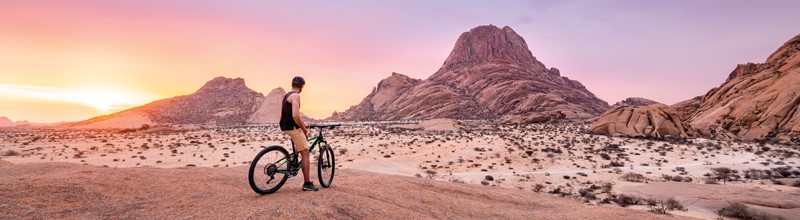
Blutkoppe, the Moon-landscape and Spitzkoppe
Ride a fat bike to explore the Swakopmund dunes
The Brandberg-Mountain area-the highest mountain in Namibia
Damaraland/a 3-night glamping adventure
Game drives in the Etosha National Park
Biking on single trails in a nature reserve north of Windhoek
Accommodation: 10 lodge / guesthouse nights, 3 Glamping nights (incl. all camping equipment)
14 days of cycling with full vehicle support
Mostly gravel roads
Group size: 6 – 12 Pax
E-Bikes available at an additional cost
Meals and accommodation as mentioned
All transport and transfers in the safari vehicle
Bike trailer for the transport of the bikes
Professional German/English-speaking tour guide
All entrance fees and activities as described in the itinerary
Mineral water while driving / biking / on camping days
Travel insurance
Visas or vaccinations
Flights
Tips
Drinks
Meals not mentioned
Mountain Bike / E-Bike
Mountain Bike Gear (Helmet, Bib, Cycling Shoes, Gloves, Arm & Leg warmers, Jacket, Socks, etc)
No details found.
Itineraries
Day 1
Arrive in Windhoek
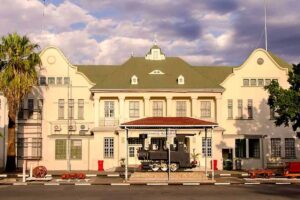
Upon arrival at the airport, we are transferred to a guesthouse on the outskirts of Windhoek. The afternoon is spent relaxing, assembling the bicycles and testing equipment. If there is time, we do a short test ride in the Avis Dam area, on quite roads and gravel roads/trails. We explore the historic and cultural highlights of the Namibian capital on a short city tour. We experience the contrasts between the architecture from colonial times and the informal settlements on the outskirts of town, where most of the people live. We enjoy dinner at the well-known Joe’s Beerhouse.
Accommodation: Ti Melen Guesthouse or similar
Day 2
Windhoek – Namibgrens Guestfarm on the edge of the Namib escarpment
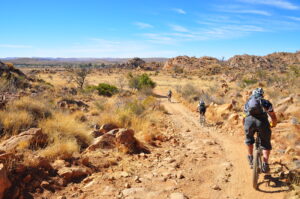
We depart from Windhoek and travel westwards into the great outdoors. We continue through the Khomas Hochland to reach the Rantberg Mountains on the edge of the Namib Desert. The road to Namibgrens and Spreetshoogte Pass is one of the lesser travelled roads and allows a scenic bike ride on a good surface, ideal as a warmup and to get used to the bikes and terrain at the start of our bike tour. We bike into this scenic farm in an area on the edge of the Namib escarpment, mountains that run south-north along the Namib desert. In the afternoon and/or the following morning we bike a jeep trail (two single trails running next to each other) and explore the farm. The route takes us through an area dotted with granite inselbergs and interesting vegetation to a viewpoint that allows us to marvel at the vast Namib desert and dunes in the distance below. It is an adventurous and slightly challenging cycle. We return to our comfortable Klipspringer chalets to enjoy a sundowner and look forward to a fine dinner.
Accommodation: Namibgrens Guest Farm or similar
Biking distance: 40 km, Altitude: 330 m
Travel distance: 180 km
Travel time: about 2.5 hour + photo stops
Day 3
Spreetshoogte Pass and the Sossusvlei Dune Sea
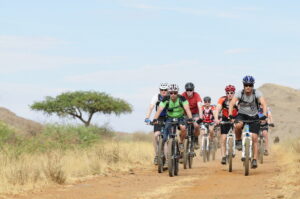
After an early breakfast, we bike on the farm trails and then from the farm on a winding road that takes us to the famous Spreetshoogte viewpoint that overlooks the wide-open plains of the Namib Desert below. The ride down the pass is a thrilling, steep downhill experience. After a few kilometres we reach a quiet country road that leads us to the start of the dune sea and to Solitaire, an oasis in the desert, famous for its apple pie and wild west town character.
At Solitaire, we load our bikes and drive the 80 km to our next accommodation in the Sesriem/Sossusvlei area.
In the afternoon, there is time to enjoy the nature area around the lodge. Depending on your wishes, we can go for a walk, another ride or a sundowner drive or simply relax around the pool and take in the views of the area.
Accommodation: Little Sossus Lodge or similar
Biking distance: 50 km, Altitude: 300 m
Travel distance: 80 km
Travel time: about 1 hour + photo stops
Day 4
Sossusvlei and Dead Vlei
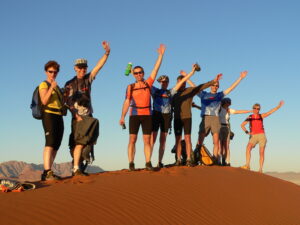
The world-famous Sossusvlei and Dead Vlei is the highlight of today. In our safari vehicle, we drive deep into the dune sea to reach various dried-out pans which fill up with water every few years after good rains. The last few kilometres are through deep sand, a challenge for our four-wheel drive vehicle. We may also want to walk part of the way. When we reach Sossusvlei we can climb one of the up to 300m high dunes and enjoy the view over the clay depressions and the sea of dunes that stretches all the way to the Atlantic Ocean. We can also walk to the Dead Vlei where ancient dried-out camelthorn trees adorn the landscape.
Not far from the gates of the Namib Naukluft Park one can visit the Sesriem Canyon and the nearby Elim dune. We can bike to both of these in the early morning or after our excursion to Sossusvlei. There is also the option to bike part of the 60km road leading into the dunes. In Sesriem Canyon the geology is particularly interesting. Here, layers that formed millions of years ago come to light.
Accommodation: Barkhan Dune Retreat or similar
Travel distance: 120 km
Travel time: about 1.5 hour – 2 hours + photo stops
Day 5
Cycling at the foot of the Rantberg Mountains/The Donkerhoek Trails, then to Swakopmund
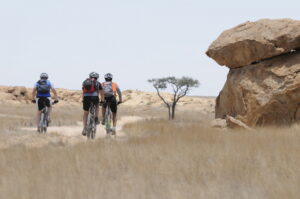
After an early breakfast, we cycle on a track in the desert savannah east of the Namib Sea of Dunes. This area lies at the foot of the Namib escarpment and the Naukluft Mountains. We travel a short distance by vehicle to reach the start of the trail. It takes us on an exciting and challenging excursion through the desert. At certain times of the year, herds of Oryx and Springbok as well as Hartmann's Mountain Zebra, can be seen along the way. Ostriches and a variety of smaller desert animals and birds are also at home here.
After a picnic lunch, we drive through the Namib into the Namib Naukluft Park, west of the Kuiseb Canyon. We encounter impressive rock formations and interesting flora. Here we find the quiver tree (Aloe dichotoma) and other interesting plants that have adapted perfectly to the extreme desert climate. We can include some biking on the easy-to-ride dirt roads on the Namibia Naukluft Park, depending on the time available.
Accommodation: Hotel Pension Rapmund close to the main beach or similar
Biking distance: 30-50 km, Altitude: 200 m
Travel distance: 270 km
Travel time: about 4 hours + Photo stops
Day 6
Swakopmund
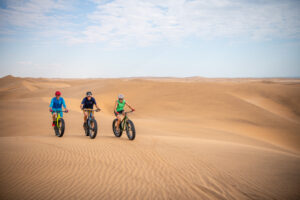
Today, after breakfast, we are introduced to our modified fat bikes and begin our ride into the sweeping dunes surrounding Swakopmund. Thanks to their wide tires, fat bikes can easily glide over sand, giving us access to areas regular mountain bikes can’t reach. The ride lasts about 2.5 -3.5 hours and may include a section along the coastline, depending on the tide.
Upon returning to Swakopmund, the afternoon is free for us to enjoy optional activities such as sandboarding or quad biking. Alternatively, we can unwind in one of the town’s renowned cake and coffee shops, known for their German-inspired treats.
Accommodation: Hotel Pension Rapmund or similar
Biking distance: 20 km (Fat Bike Tour)
Day 7
Moon landscape and Spitzkoppe
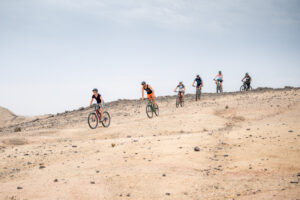
We are transferred by car to the nearby Moon Landscape and within minutes find ourselves sandy but firm trails along the Swakop ephemeral riverbed and into the Moon Landscape. This unique area, known as the “Badlands”, borders the linear coastal dunes and the gravel plains found further inland to the east. A labyrinth of bike trails in an area that feels and looks like the moon, we ride a desolate route to reach Goanikontes Oasis with its rustic restaurant and lodge under the large palm trees. The infrastructure dates to colonial times, when the first immigrants from the lake district in England started farming here to provide Swakopmund with fresh produce.
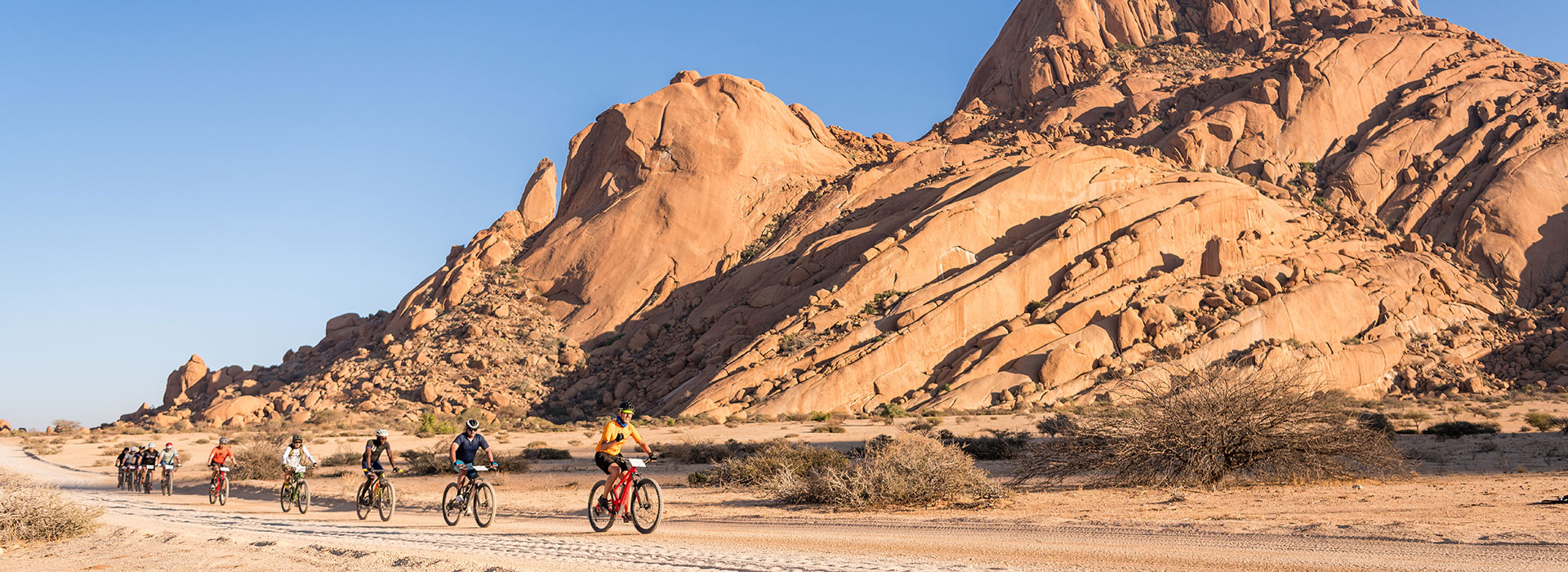
From Goanikontes we drive eastwards to reach the southern part of an area called Damaraland, home to the Damara tribe. The area includes three large granite inselbergs/mountains, namely the Spitzkoppe, the Erongo Mountains and the Brandberg, Namibia’s highest mountain. We can cycle the last 20-30 kilometres to our campsite at the foot of this beautiful, massive granite inselberg, the Spitzkoppe, known as the ‘Matterhorn’ of Namibia.
Accommodation: Spitzkoppe, Camping
Biking distance: 40-50 km, Altitude: 200 m
Travel distance: about 120 km
Travel time: about 1.5 hours + photo stops
Day 8
Save the Rhino Camp, Ugab Ephemeral River, Brandberg
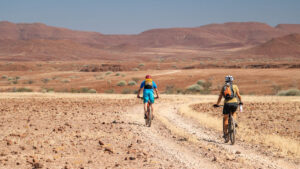
The landscape around Spitzkoppe and the surrounding granite mountains is unique in the Namib. You could spend days here exploring, climbing, studying the interesting flora and cycling. We enjoy an early breakfast in the shade of the Spitzkoppe.
We bike out of the Spitzkoppe area on a road that continues all the way to Cape Cross on the Skeleton Coast. After our lunch stop, we continue the route past the Messum Crater in the direction of the Brandberg, Namibia’s highest mountain. The landscape is geologically very different from what we have seen so far. Endless plains and mesas, remnants of the Karoo era, dominate the landscape and are reminiscent of old western films. As we drive through this region, we may see various species of antelope and other animals. In the afternoon, we cycle on a quiet dirt road with a view of the Brandberg Massif and through a steep side gorge of the Ugab River to our sheltered campsite at Save the Rhino Camp.
Accommodation: Ugab Save the Rhino Camp, Camping
Biking distance: 40-50 km, Altitude: 220 m
Travel distance: 150 km
Travel time: 2 hours
Day 9
Doros View Camp, Damaraland
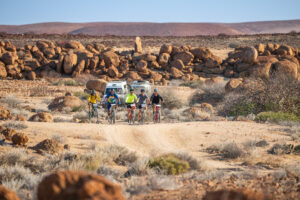
The dry Ugab River has carved its way to the Atlantic over millions of years. A linear oasis, the vegetation along its banks provides food and shelter for many wild animals. We cycle through the riverbed of the Ugab and take on the challenge of a rocky gorge. Here, at the confluence of the Ugab and Huab rivers, we may encounter desert elephants that have adapted to the extreme conditions. With luck, we may also see other animals such as giraffe, zebra, springbok and oryx.
From the watershed/on the plateau we have magnificent views of the Brandberg and Karoo sandstone formations. This remote area is little visited; sometimes days go by without seeing another vehicle or people. We have it all to ourselves, a refreshing feeling considering how busy the world has become. We bike on a two-track trail to the Doros Crater area. Apart from the scenic and beautiful Karroo landscape and granite rock formations, we have views of the Brandberg massif to the south and the volcanic Etendeka Plateau to the north.
Accommodation: Doros View wild camping
Biking distance: 40-60 km, Altitude: 240 m
Day 10
Biking sandstone mountain trails to the World Heritage site, Twyfelfontein
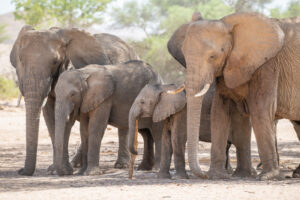
The dry and rocky desert plain reaches west from Twyfelfontein to the Skeleton Coast. This remote region is home to a variety of wildlife - zebra, giraffe, oryx and kudu antelope, desert lion and the rare black rhino. We cycle on gravel two-track trails to reach remote valleys where, after good rainfall, small herds of rare mountain zebra and giraffe can be found.
The sandstone mountains of Twyfelfontein are the remains of an ancient desert that occurred more than 280 million years ago. More than 2500 rock engravings are engraved on over 200 rock slabs, the oldest of these dates to the Stone Age, to a time when these mountains provided protection and water to hunter-gatherers.
Accommodation: Damara Mopane Lodge 80 km east of Twyfelfontein or similar
Biking distance: 30 km, Altitude: 300 m
Travel distance: 110 km
Travel time: 2 hours
Day 11 & 12
Etosha National Park
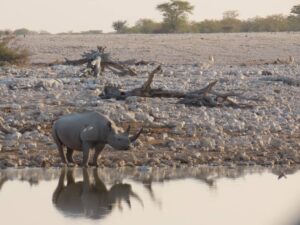
After many days in the Namib Desert of western Namibia, our journey takes us eastwards via the geologically interesting Ugab Terraces to Vingerklip and the Etosha National Park. We bike this “Marlboro Country” along the banks of the Ugab River with views of the sedimentary rock formations created millions of years ago, one of the most unique ones being the finger-like rock protrusion called the “Finger Rock”.
After lunch at the Vingerklip Lodge, we are transferred by vehicle to a lodge near the gates of Etosha National Park. Etosha is one of the most special game parks in Southern Africa and is over 22000 km2 in size. Etosha means “great white place” and refers to the huge 5000 km2 salt pan that gives its name to the park. The park is teeming with different animal species, including lions, rhinos, and elephants. We explore the park with our guide and tour vehicle.
Accommodation: Taleni Etosha Village or similar
Biking distance: 30-40 km, Altitude: 300 m
Travel distance: 200 km
Travel time: 2-2.5 hours + photo stops + game drive in Etosha National Park
Day 13
Bike trails near Okahandja
After an interesting time in Etosha, it is time to start the journey back to Windhoek. After breakfast, we head south towards civilization, arriving in Okahandja in the early afternoon. The name is derived from Otjiherero and means "the place where two rivers flow into each other to form a wide one". Known for its large camel thorn trees, it is our last oasis before we prepare for our journey home. We enjoy the afternoon biking on the trails of the nearby farm, Ongeama. On a network of jeep tracks and single trails, we bike this interesting nature area, home to a variety of antelopes and other animals.
Accommodation: Okahandja Country Hotel
Bike distance: 20 km
Travel Distance: about 340 km
Travel time: 3.5-4 hours + breaks and photo stops
Day 14
Windhoek Departure Day
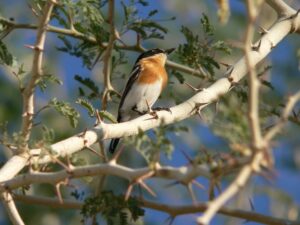
Unfortunately, our Namibia adventure is slowly coming to an end today. Depending on the time of our departure flight, we may still have time for a final bike ride or a morning walk in the Ongeama nature area. Before our departure to Windhoek, we can stop at the woodcarvers' market in Okahandja to look at the handmade carvings and buy some souvenirs. Alternatively, or better still, we can spend a little time in Windhoek before departing for the airport, the Craft Centre a special place and a final walk through the city centre may also be worth the while.
Driving distance: 120 km
Travel time: 2-2.5 hours
| Dates 2026 (from/to Windhoek): |
| 26 September 2026 - 09 October 2026 |
| 24 October 2026 - 06 November 2026 |
| Price for the Bike Tour: |
| Per person sharing ZAR 96,600 |
| Single supplement ZAR 6,400 |
| Mountain Bike Rental ZAR 8,750 (Scott Spark 960 or Specialized Stumpjumper Alu full suspension MTB with 29-inch rims) |
| Scott Spark Strike E-ride, E-bike: ZAR 14,000 |
| Price valid as from 6 participants, under 6 participants price on request |
Namibia is a large country and during our two weeks tour we travel about 2500 km. The trip is planned in such a way that guests cycle the most beautiful sections, thus avoiding long hours spent in the vehicle and spending more time on the bike in the great outdoors. The cycling is focused on off the beaten tracks, roads and trails. The tour follows the classic route meaning that most of the most famous highlights of Namibia are experienced on this tour.
Level of difficulty:
Level 1 – Beginners Level 2 – Intermediate biking experience Level 3- Advanced
Our tour would be considered a Level 2 tour. If we have beginners or more advanced riders along, we can adapt the tour to suit the abilities of the guests. For example, we can add a challenging extra ride on certain days for participants that need a little more action. This also allows experienced bikers to enjoy this tour with family or friends who have a different level of biking experience and fitness. Guests with less experience can ride as far as they can and then load their bike on the trailer and continue in the vehicle. The support vehicle is always near/close behind, should you require assistance.
Weather:
From June – August, the days are clear and warm, nights can be cold. September – May, the weather is considerably warmer, with the hottest months being October – April. Despite the heat, it’s a dry climate, and temperatures do drop at night. The rainy season typically runs from November – February.
Safety:
Helmets must be worn by all cyclists in Namibia.
Flight information:
We recommend booking a departure flight that leaves no earlier that 15h00 on the day of departure.
Passport:
Make sure to check your passport’s expiration date. Namibia requires passports to be valid for at least six months beyond your scheduled return date.
Visa:
As of 1 April 2025, travellers from the UK, US, Canada, and some EU states, will need a visa to enter Namibia.
To view the entire list and costs involved please visit the following link: Visa Requirements
Vaccinations:
No vaccinations for Namibia are required, but it is recommended to get vaccinated for hepatitis A, hepatitis B, tetanus, typhoid, cholera, rabies, and tuberculosis.
If arriving from or transiting for over 12 hours through a yellow fever risk area, a yellow fever vaccination certificate is necessary. Please very all requirements and recommendations with your doctor.
Fixed departure dates and individually planned bike tours:
For the NAMIBIA CLASSIC BIKE Tour there are three fixed departure dates every year.
Alternatively, we can work out a tailor-made tour for you, depending on your time available, level of difficulty, standard of the accommodation and the travel route.
Travel service, vehicles, and equipment
The NAMIBIA CLASSIC BIKE tour will be guided by an experienced bike guide. On most of the biking sections the guide will be joining you on his bike. A tour assistant will drive the support vehicle and assist the guests with all their needs, loading and un-loading the bikes and so on.
The NAMIBIA CLASSIC BIKE tour is ideal for groups with 4 to 12 participants. For smaller groups a Toyota Landcruiser 4x4 will be used, however for larger groups we use a 14-seater VW Crafter.
Our Scott Bikes, Model 960 (or alternatives with comparable quality standards) are equipped with 29-inch rims and full suspension and are regularly serviced and in good condition. These bikes are suitable for our local conditions. All bikes are equipped with tubeless tires, which are resilient and perfect for the local terrain. We leave nothing to chance, and we make sure our guests have the ultimate biking experience. Specially designed trailers for transporting the bikes allow for easy loading, they have enough space for all the equipment and luggage.
Scott Spark 960 or Spezialized Stumpjumper 29-inch rim full suspension Mountain Bikes
E-Bike Option: Scott Strike or Spezialized Levo